1
Division of team roles
Division of team roles
Content
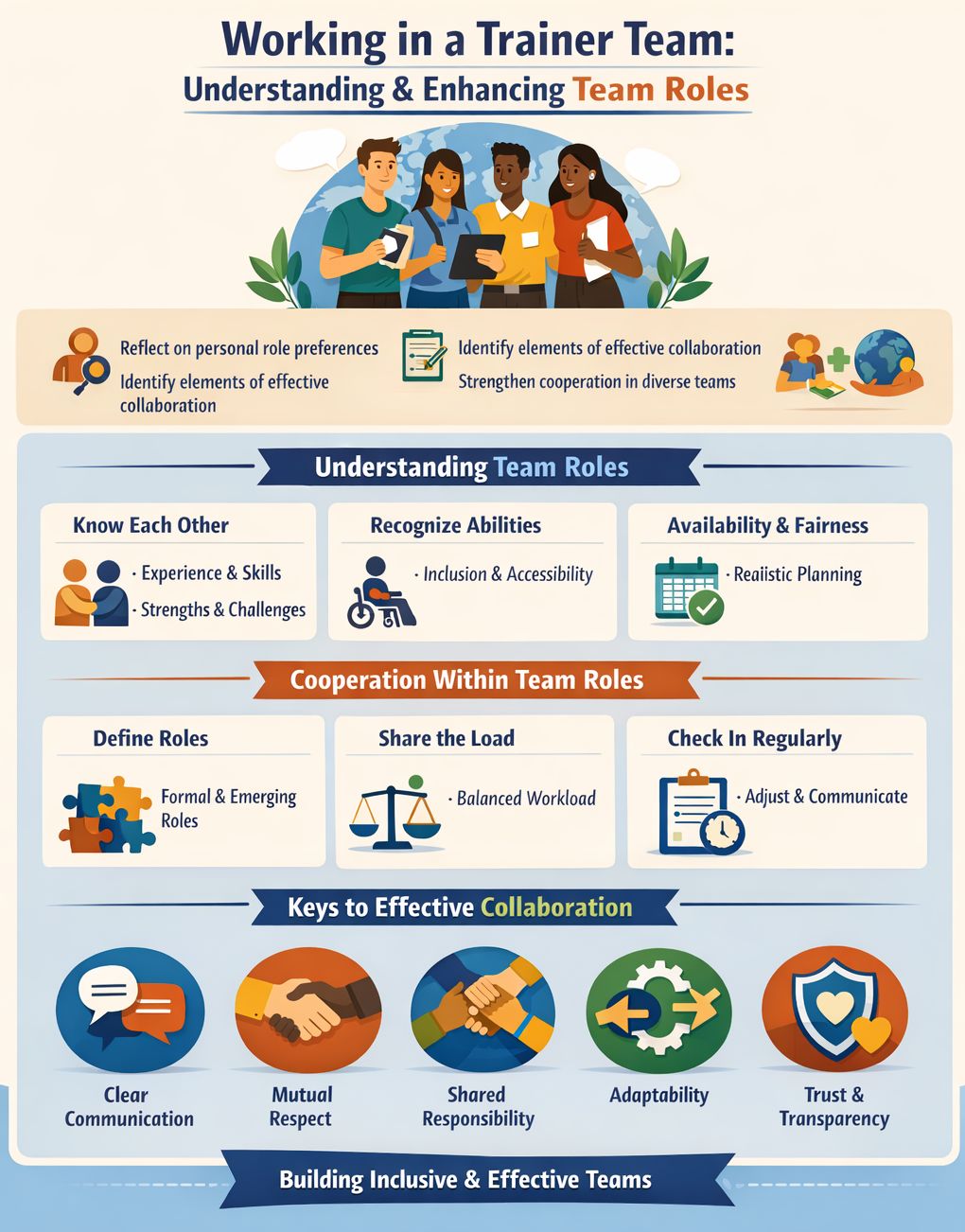
Working in a trainer team goes beyond dividing tasks. It involves understanding different skills, working styles, communication patterns, expectations, and responsibilities. Some roles are assigned, while others naturally emerge through experience, confidence, or group needs. This activity supports team members in exploring how roles are distributed, how they influence cooperation, and how to work in a more balanced, inclusive, and effective way.
Objectives:
- Reflect on personal preferred roles in teamwork
- Identify key elements of effective collaboration, such as clear communication, mutual respect, shared responsibility, adaptability, and trust
- Strengthen cooperation in international and diverse team settings
Understanding team roles
Getting to know each other is essential for effective teamwork. This includes awareness of each member’s experience, background, skills, strengths, and expertise. It also involves recognising abilities and disabilities to ensure inclusive collaboration. Clear understanding of availability helps with realistic planning and fair distribution of responsibilities. You can find more about roles in Identifying Group Roles (PDF) and Roles in groups (PDF) .
Cooperation within team roles
Defining needed roles is key to effective cooperation. Teams should also consider informal or emerging responsibilities and ensure roles complement each other. Fair distribution of tasks and workload builds transparency, trust, and shared responsibility. Regular check-ins help keep expectations clear, ensure roles remain manageable, and allow adjustments when needed. You can find more about teams in T-Kit 6: Training Essentials (PDF) and The right team composition - nice overviewing article about team composition (PDF).
***
Division of team roles activity
Step 1. Organise a team meeting to understand the needs of team members and their motivation.
- Share your reasons and expectations to join the team
- Share your needs regarding participation in the team
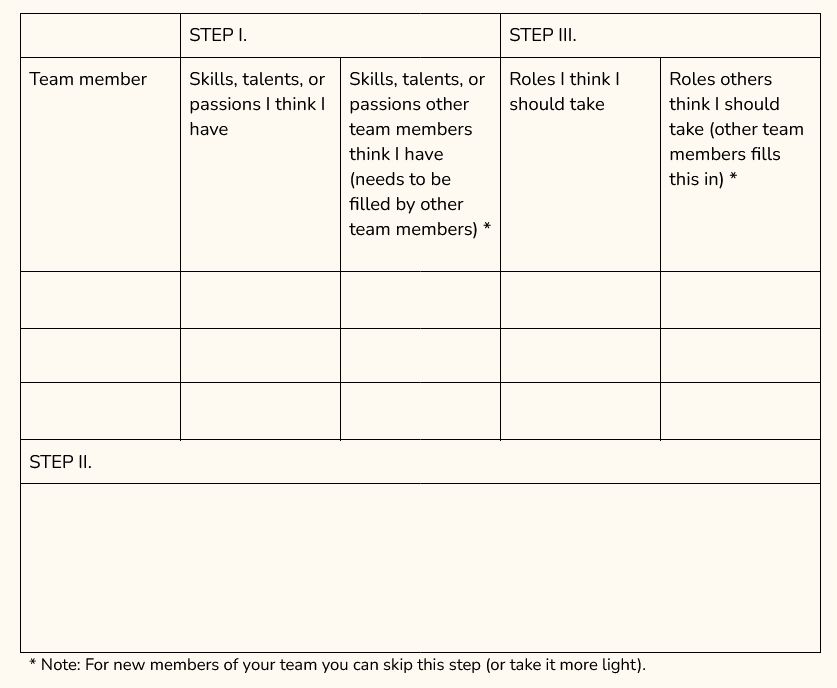
- Step I. - you and your team members are filling in the table about your skills, talents, or passions (especially in new teams, focus more on passions and talents than skills, maybe)
- Step II. - list all possible team roles (if you need a hint, here are some examples of team roles)
- Step III. - you and your team members are filling in the table about your team roles by matching in the skills, talents and passions of each person to a fitting role (merge information from step I. and II.)
TABLE of role division activity:
Step 3. Discuss the results from the table
- Is everybody comfortable with the suggested roles?
- Is everyone included in the teamwork?
- If not, how can you change the role in order for people to use their skills (strengths) to the fullest?
- Is any role missing?
Step 4. Give another round of discussion about the following:
- How to use these roles in harmony?
- How is cooperation between the roles ensuring effectivity?
- Is the division of tasks, workload and compensation fair?
Step 5. Team role revision
- Do regular check-ins with team members to see if any adjustments are needed, e.g. on a weekly basis. (You can use the questions from steps 3 and 4.)
- In 1 month check how each role contributed to achieving shared team goals, achieving key milestones on the way, contributions to successful outcomes.
- In 3 months gather peer anonymous scaled feedback on teamwork, share fulfilling of expectations of their role, note when someone helps beyond their role, share their contributions (learning and value). Share on topics such as contributing meaningfully, meeting participation, communication flow, and conflict resolution. See if there are any unidentified roles you need to cover (based on team members feedback).
- More tips and tricks for better team composition.
Tip: How to use this when you are:
- Individual
You use the activity to reflect on your own strengths, motivations, and preferences. Then you identify which team role fits you best so you can clearly communicate it when joining a team.
- Group without facilitation
The team works through the activity together on their own. Members share their strengths, suggest roles, and decide who does what through open discussion. It’s quick but may miss quieter voices. Can be done online, on the first day of a meeting of your team.
- Group with facilitation
A leader guides the process step by step. Everyone reflects, shares, and is supported in choosing a role that fits them. This leads to a more balanced, fair, and effective team. Can be done online, or in person.
***
Trainers competences
Training of trainers course participants created this educational activity and resources to support trainers teamwork competence development. The Awero team organised the course.
This activity supports trainers’ competence development in the Cooperating successfully in teams area. Activity content and badge-issuing criteria aligned with the European Training Strategy (ETS) competence model for trainers working internationally. In particular:
- Contributing actively to team tasks
- Being willing to take on responsibility
- Encouraging and involving other team members
- Learning with and from others
- Being aware of the team processes and how they affect the team’s effectiveness
- Managing disagreements constructively

Resources
Get activity badge
Division of team roles Get this badge
The badge earner took part in team roles activity, exploring how team roles are identified and distributed for team effectiveness, how they influence cooperation and how a trainer team can work in a more balanced, inclusive, and effective way.
To get this badge, trainer:
- Explored the motivation and needs of each team member.
- Identified their skills and the skills of their team mates.
- Identified the roles needed for the project.
- Matched the skills to the roles.
- Strengthened awareness of how the division of the roles influence the cooperation in the team.
Activity content and badge issuing criteria aligned with the European Training Strategy (ETS) competence model for trainers working internationally.
Learning duration: 90 mins.
Tasks
Task no.1
Evidence verified by: one activity organiser
To get this badge:
- Share your discoveries and experiences from the division of team roles activity.
- Reflect on how your skills contribute to the teamwork ensuring the success of the project
- Add a filled-in chart of your team roles as an evidence (optional)
Skills
ETS-TR
#Masters methods and techniques to support a clear and fair division of roles and responsibilities
Organisers
Awero
Badge issuer recognized with

Awero not-for-profit organisation manages this platform and develops it together with leading educational organisations. The European Union's programme Erasmus+ granted co-funding for building the first version of this platform. Contact support@awero.org.
Platform
Change to another language: